RoboRigor
Certified by the Ceiling:
Saturated Benchmarks Supply the No-Loss Claims Behind VLA Acceleration
Technical report, 2026. Extends the RoboRigor workshop paper with a census of no-loss claims.
TL;DR
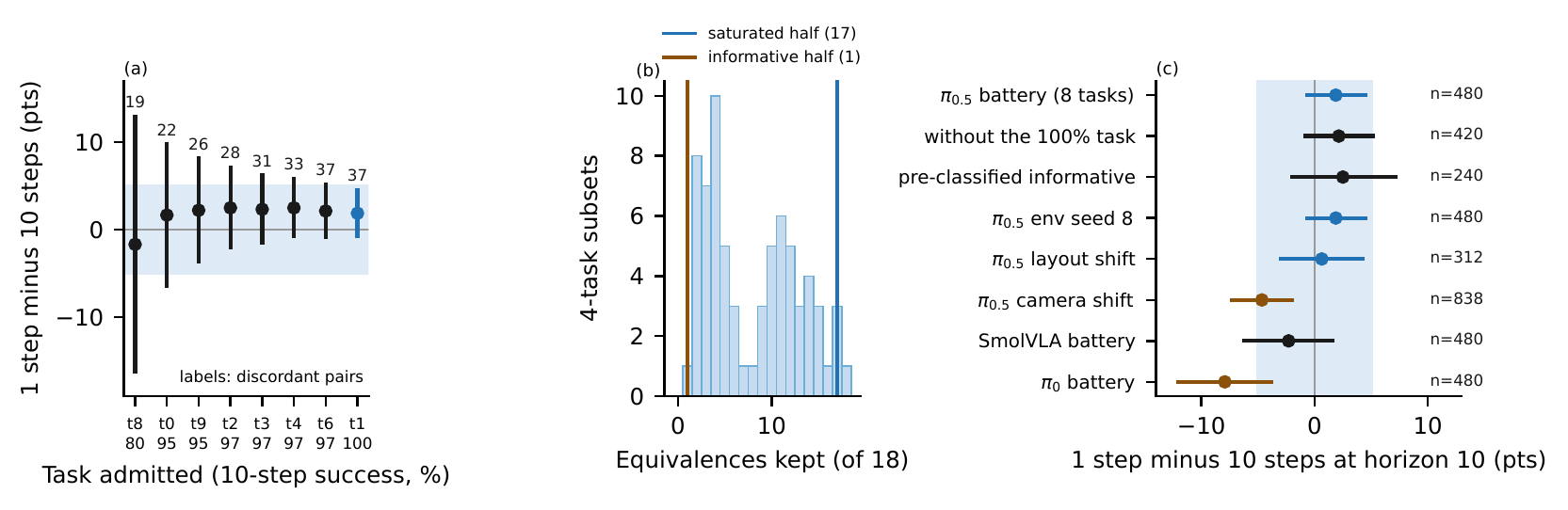
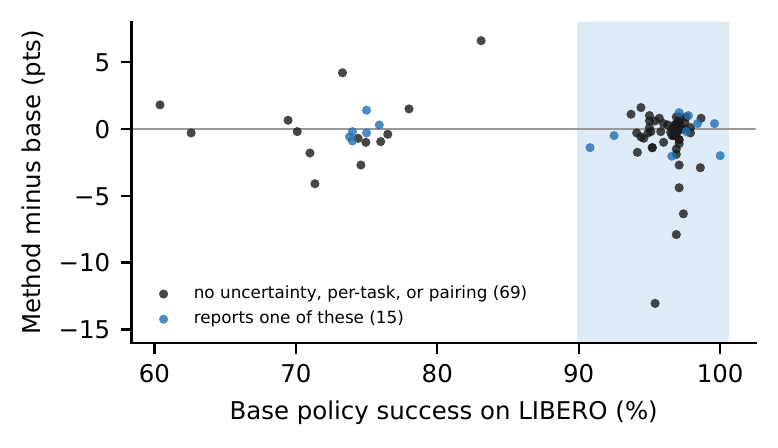
Papers that make VLA policies cheaper to run justify their speedups by showing no loss on LIBERO, where base policies typically succeed in more than 90% of episodes. Those no-loss verdicts are supplied largely by tasks both settings already solve, so they say little about the tasks on which policies fail. On released pi0.5, one denoising step is equivalent to ten within plus or minus 5 points on an eight-task LIBERO-10 battery, yet inconclusive on the four tasks classified as informative before the experiment. Across all 79 paired comparisons in our grids, the saturated tasks keep 17 of 18 equivalence certificates and the informative tasks keep 1, while the informative tasks keep 57 of 59 significant differences. Among 86 VLA efficiency papers claiming parity on LIBERO, the median base policy succeeds in 96.4% of episodes, where a plus or minus 5-point margin tolerates 2.35 times the base's failures, and 15 report any uncertainty, per-task result, or paired analysis.
Findings
- Saturated tasks supply the certificate. Pairs of episodes both settings solve tighten an absolute-difference interval for the pooled average while carrying no information about the episodes on which a setting could fail, the leniency of absolute margins at low event rates long documented for non-inferiority trials. On pi0.5 the one-step contrast is equivalent on the battery ([-0.7, +4.5] points) and inconclusive on the informative tasks ([-2.0, +7.1]).
- The pattern is systematic. At equal episode counts, the four saturated tasks keep 17 of 18 equivalence certificates but only 38 of 59 significant differences; the four informative tasks keep 1 and 57. The asymmetry holds under unpaired and paired intervals, a 90% rule, and a plus or minus 7-point margin.
- Where failures are common, verdicts diverge. One step costs released pi0 7.9 points (p=0.00025) and pi0.5 7.1 points on the hardest camera-viewpoint shifts (LIBERO-Plus levels 4-5, p=0.00003), while on levels 1-3 the contrast is inconclusive; it is inconclusive for SmolVLA.
- No single margin scale is safe. A failure-rate ratio ignores solved tasks and removes the dilution, but under camera shift, where most episodes fail, it certifies non-inferiority even though failures rise significantly. Absolute margins are lenient when failures are rare, relative margins when they are common.
- The efficiency literature makes its claims in this regime. Of 86 papers claiming parity with their base policy on LIBERO, 64 of the 84 with numeric rates start from a base at or above 90% success, 15 report any uncertainty, per-task result, or paired analysis, and 45% state no usable episode count. The audit does not show that the certified shortcuts are costly; it shows the certificates cannot tell.
Check a no-loss claim
The toolkit ships the three-part report the paper recommends: discordant pairs with an exact conditional odds-ratio interval, the paired interval on tasks declared informative in advance, and a failure-rate ratio against a declared bound.
pip install -e ".[stats]"
roborigor report --a runs/fast --b runs/base --informative-tasks 0,2,8,9

all tasks          n=480  96.5% vs 94.6%  diff +1.9 [-0.7, +4.5]  b-c 23-14  -> EQUIVALENT
informative        n=240  94.2% vs 91.7%  diff +2.5 [-2.0, +7.1]  b-c 17-11  -> INCONCLUSIVE
failure ratio A/B 0.65 [0.31, 1.21]  -> within bound
warning: equivalence on all tasks does not hold on the informative tasks
Data and tooling
31,858 per-episode records on released pi0.5, pi0, and SmolVLA across LIBERO and LIBERO-Plus, with a datasheet; a paired evaluation harness with exactly-once resume; exact intervals, power calculations, and variance decomposition. Every number in the report regenerates from the records with the released scripts.
BibTeX
@misc{gunukula2026ceiling,
  title        = {Certified by the Ceiling: Saturated Benchmarks Supply the No-Loss Claims Behind VLA Acceleration},
  author       = {Gunukula, Nihal},
  year         = {2026},
  howpublished = {Technical report},
  url          = {https://nihalgunu.com/roborigor/certified-by-the-ceiling.pdf},
  note         = {Code and per-episode logs: \url{https://github.com/nihalgunu/roborigor}}
}