Weights or Sampling?
A Controlled Study of Reward Optimization in Flow-Matching Models
soon
TL;DR
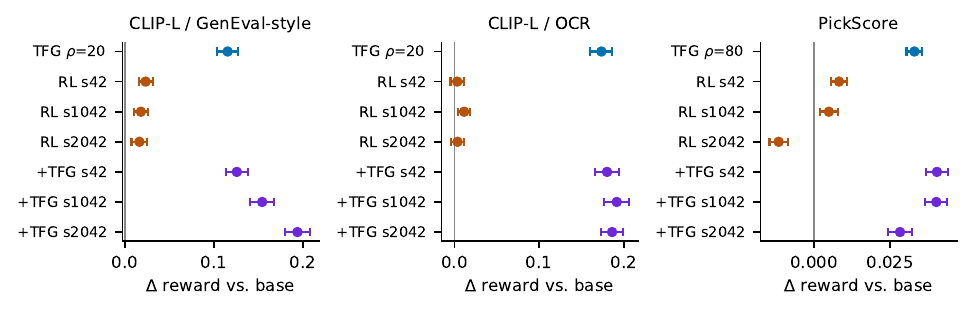
To make a flow-matching image model score higher on a reward, the reward can go in two places: trained into the weights with reinforcement learning, or spent at sampling time as guidance. Held to one backbone, one frozen reward model, and one budget, guidance wins on every differentiable reward we test, by 1.6× to 7× over tuned RL, and the margin is predictable before you train. The result is not a winner but a measured map of conditions, each with a mechanism: guidance consumes the true per-sample reward gradient where it applies, while RL must estimate that gradient from scalar rollouts and amortize it into prompt-independent weights.
Findings
- Two cheap measurements predict the margin. The initial slope of the guidance dose-response predicts how far guidance can push a reward; the cross-prompt similarity of the reward gradient predicts how much of that RL can amortize. Together they are a pre-flight diagnostic: you know which side of the map you are on before spending a GPU-hour on training.
- Training wins in two regimes, and only there. When the reward is non-differentiable (guidance cannot run) and when it is fully prompt-independent. On a prompt-independent aesthetic reward, three matched-budget RL seeds average +0.142 and tie matched-strength guidance, the one place training closes the gap.
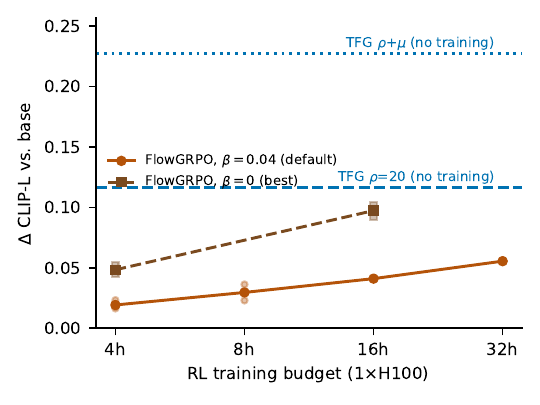
- The default handicaps RL, and single runs mislead. A KL coefficient shipped upstream quietly halves RL's gains; at the fair setting single runs still swing from harmful to helpful across seeds, and below a rollout-group threshold training actively destroys the policy. The comparison is only fair once these are controlled.
- Guidance composes, with itself and with RL. Its cheaper denoised-estimate branch beats the standard one and the two together double the gain; stacked on a trained checkpoint the families add rather than cancel, and partially rescue a failed run.
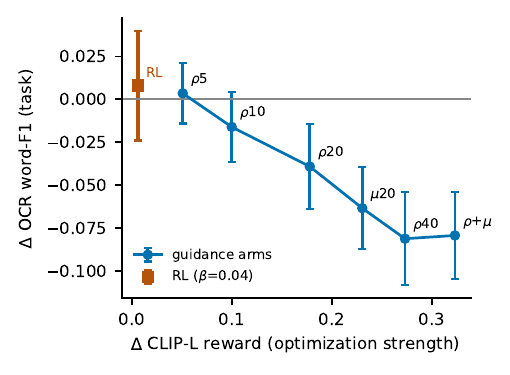
- Reward gains convert weakly into task gains, worst for the strongest optimizer. Under external, task-grounded audits (literal OCR readability, a detector protocol, a cross-architecture judge), reward-model improvements dissociate from real task improvements, and the dissociation widens with optimization strength. Past a point the binding constraint is the reward model, not the optimizer.
Reproduction
Every number in the paper recomputes from released per-prompt, per-seed evaluation matrices under one prompt-clustered recipe, and every run is reproducible from the released scripts: training uses fixed initialization and rollout seeds. Trained checkpoints and full logs are provided where retained.
BibTeX
Citation will be posted when the preprint is up (in progress).
Figures and numbers are generated from the released evaluation data.